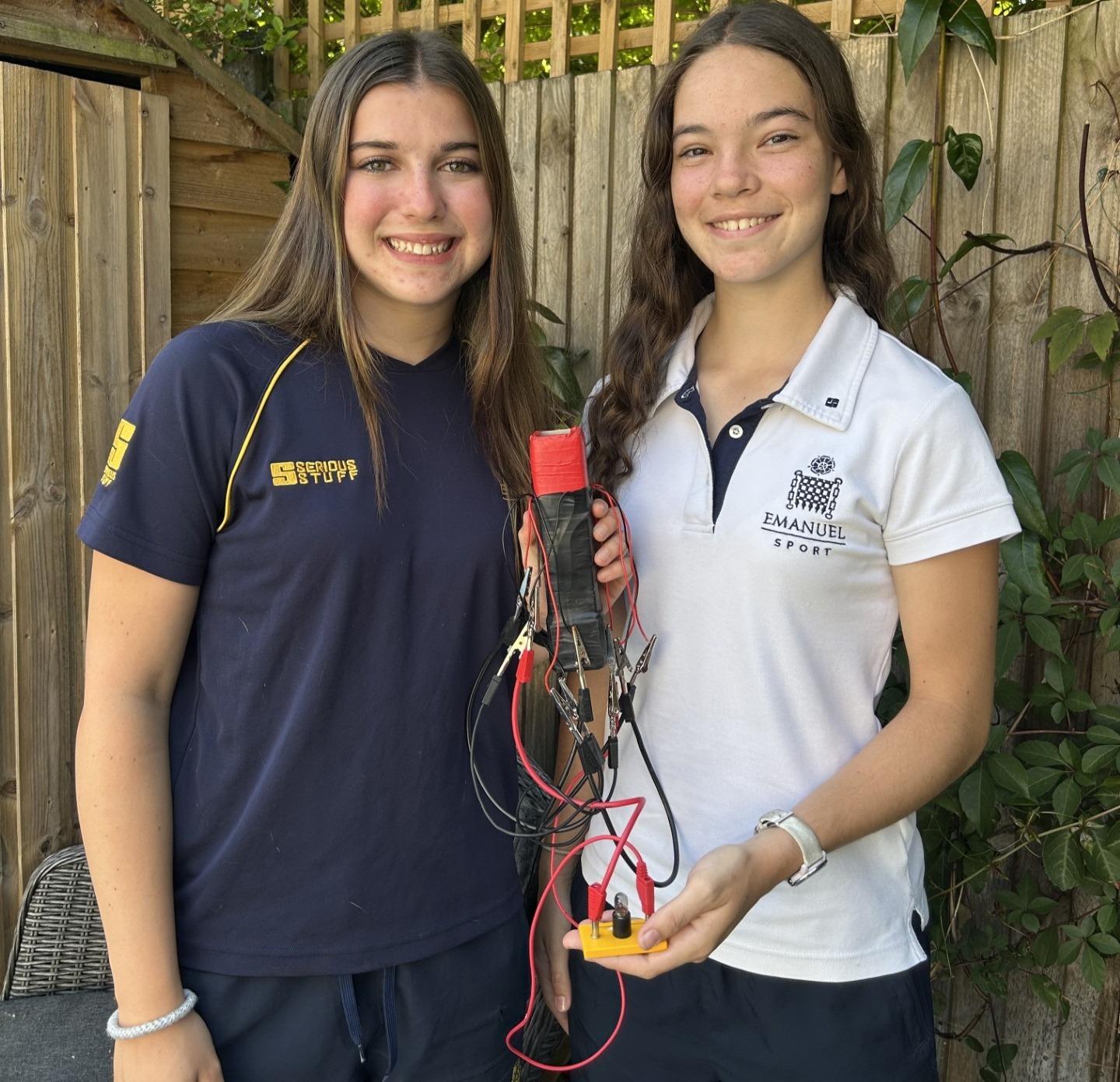
Congratulations to our 2026 third-place winners, Daniela and Amelie from Emanuel School. In their entry, Rot-to-Watts, they explored how thermal energy generated during the decomposition of compost can be converted into electricity using thermoelectric generators and the Seebeck effect. Take a look at their entry and cover letter:
We are using thermal energy from the decomposition of compost to create an electric current.
The prototype is a small, very well-insulated box that can be inserted into hot compost (which can reach 49–71°C). It contains thermoelectric generators (TEGs), which work by using the Seebeck effect, converting a temperature difference into electrical energy. Hot electrons in the semiconductor material move towards the cooler side, creating a voltage potential. This means that as long as one side is in the compost and one side is in the cooler outside, we can use it to power a small bulb.
It can be used as a sustainable way to generate energy to charge batteries, power emergency lights or weather monitors.
It is also a sustainable way to use food waste for another cause, rather than it just going to waste.